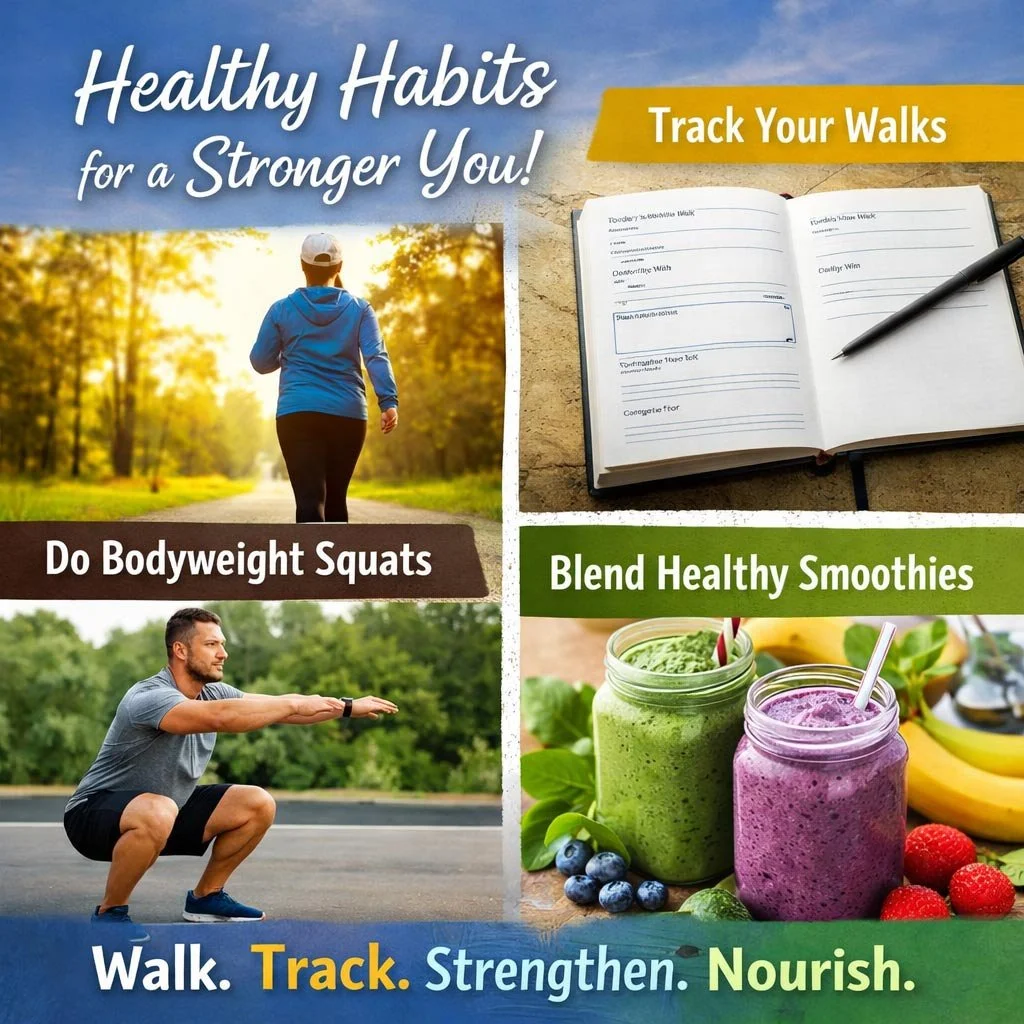
This week’s WIN Newsletter focuses on the small, practical habits that quietly drive long-term health—tracking your walks, walking with intention, strengthening your body, and fueling yourself well. These are not complicated strategies, but they are proven ones, and when practiced consistently, they build momentum that lasts far beyond motivation alone.
Start Your Week with a WIN
If you found this helpful, I invite you to join the Walking Inspiration Newsletter (WIN) and receive weekly guidance, research-backed insights, and simple action steps to help you walk stronger, think clearer, and live healthier:
Why Small Habits Create Big Health Wins
When it comes to health and fitness, most people believe progress requires big changes and intense workouts. In reality, the opposite is often true. The most effective fitness routines are built on simple, repeatable habits that support consistency over time.
Three of those habits stand out:
Tracking your activity
Walking with intention
Fueling your body with nutrient-dense foods
Let’s break them down.
Tracking Your Walks: The Power of Writing Things Down

One of the most underrated fitness tools is a journal. Tracking your walks—time, distance, and how you feel—creates awareness and accountability.
In Week One of a structured walking logbook, the focus isn’t perfection. It’s observation.
You begin by recording:
How long you walked
How the walk felt physically and mentally
One small daily win
One moment of gratitude
This practice helps you recognize patterns. Many people notice improved mood, better energy, and increased motivation simply because they’re paying attention. Writing things down turns walking from a task into a habit—and habits are what lead to long-term results.
One of the simplest—and most powerful—tools I’ve ever used to stay consistent is writing things down. That’s exactly why I created The Walking Logbook Journal.
Brisk Walking: Why Pace Matters More Than You Think
Research continues to confirm what walkers have known for years: how you walk matters.
In Podcast Episode 29, Vanderbilt Study Proves: Brisk Walking Works Better Than You Think, research from Vanderbilt University highlights how brisk walking can significantly improve cardiovascular health and metabolic function.
The key takeaway is simple:
You don’t need extreme workouts to get meaningful results.
Walking at a brisk but sustainable pace:
Improves heart health
Enhances endurance
Is easier to maintain long term than high-intensity exercise
Consistency beats intensity every time.
Did You Know? Bodyweight Squats Do More Than You Realize
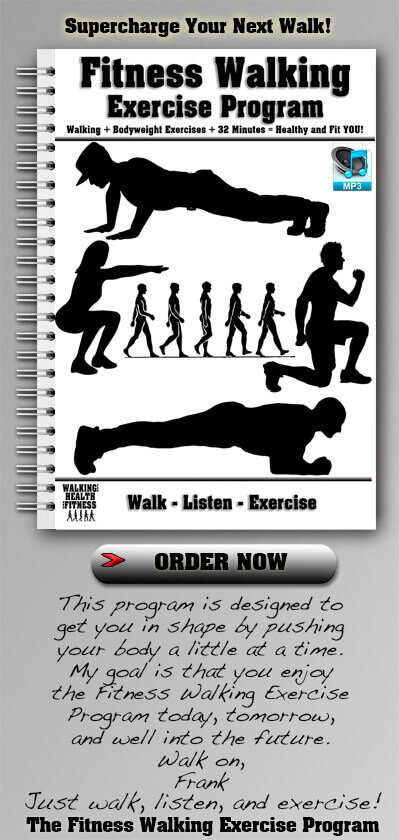
Bodyweight squats are one of the most efficient exercises you can do—especially when paired with walking.
Squats activate:
Glutes
Quadriceps
Hamstrings
Core muscles
They also improve balance, joint mobility, and functional strength, which directly supports better walking mechanics and injury prevention. Adding even a short set of squats after a walk can amplify lower-body strength over time.
Check out how to TRANSFORM YOUR WALK: 32 MINUTES TO STRENGTH, ENERGY & CONFIDENCE
Why Smoothies Are a Smart Health Habit
Smoothies are one of the easiest ways to deliver high-quality nutrition to your body—especially after a walk.
A well-made smoothie can:
Support digestion with fiber
Reduce inflammation through antioxidants
Improve hydration
Provide sustained energy
A balanced smoothie includes:
A liquid base (water, almond milk, kefir)
Leafy greens (spinach or kale)
Fruit (berries are especially beneficial)
Protein or healthy fats (Greek yogurt, seeds, nut butter)
Because circulation is elevated after walking, your body is primed to absorb nutrients efficiently.
The Big Picture: Simple Habits, Lasting Results
Walking works best when paired with small supportive habits:
Track what you do
Walk with intention
Strengthen your body
Fuel yourself well
None of these require extreme effort—but together, they create momentum. And momentum is what keeps you moving forward, week after week.
Walk on,
Frank S. Ring
Author: Walking for Health and Fitness, Fitness Walking and Bodyweight Exercises, Walking Inspiration, Walking Logbook Journal , and Walking Works Blueprint


