You’re Not Weak
If you’re undergoing prostate cancer treatment—or have recently completed it—and feel weaker, heavier, slower, or more exhausted than you expected, this needs to be stated clearly:
This is not a lack of discipline.
It is not a mindset failure.
It is not you “letting yourself go.”
What you are experiencing is a predictable biological response to androgen deprivation therapy (ADT), radiation, and the stress they place on the body.
When men aren’t told this, they often fill the gap with self-blame. This post exists to remove that shame, explain what’s happening, and show you how to respond intelligently—not aggressively—during treatment.
What ADT Does to Testosterone, Muscle, and Metabolism
ADT works by suppressing testosterone to slow or stop prostate cancer growth. Medically, this can be life-saving. Physiologically, it creates rapid and measurable changes throughout the body.
Research published by the National Institutes of Health shows that men on ADT commonly experience:
Accelerated loss of lean muscle mass
Increased fat accumulation, especially visceral fat
Reduced insulin sensitivity
Slower resting metabolic rate
Declines in bone density and physical strength
Testosterone plays a critical role in muscle protein synthesis, energy regulation, and fat metabolism. When levels drop quickly—as they do with ADT—the body shifts into a conservation state.
This is why men often say:
“I’m doing less, but gaining weight.”
“I feel weaker even though I’m trying.”
That is not perception. That is physiology.
Source: National Library of Medicine
If this resonates, you may also want to read Why Survival Is Not Enough After Prostate Cancer, where I explain why getting through treatment is only the first step—and why men need support learning how to live well afterward.
Why Energy Crashes Feel Random and Unpredictable
One of the most unsettling symptoms during treatment is fatigue that feels inconsistent and uncontrollable.
Cancer-related fatigue is not ordinary tiredness. It is driven by:
Hormonal suppression
Inflammatory responses from radiation
Sleep disruption
Reduced mitochondrial efficiency (cellular energy production)
According to the American Cancer Society, cancer-related fatigue does not reliably improve with rest alone and is often unrelated to how much activity you performed the day before.
This explains why:
One day feels manageable
The next feels like your energy disappears
Naps don’t restore you the way they used to
Your body is recalibrating under stress.
Source: Cancer.org
The Hidden Danger of Stopping Movement Entirely
When fatigue hits, many men are told—explicitly or implicitly—to stop moving and “just rest.”
Rest is necessary. Rest alone is not neutral.
The National Cancer Institute reports that prolonged inactivity during cancer treatment accelerates:
Muscle loss
Cardiovascular deconditioning
Insulin resistance
Longer recovery timelines after treatment
The body adapts quickly—to movement and to stillness.
Stopping movement entirely teaches the body to downshift further.
Source: Cancer.gov
Why “Rest Only” Advice Backfires
Here’s the paradox most men are never told: Appropriate movement reduces fatigue more effectively than rest alone.
Clinical studies consistently show that light-to-moderate physical activity during treatment improves:
Energy regulation
Mood stability
Muscle preservation
Treatment tolerance
The issue is not movement.
The issue is how movement is applied.
Trying to train like your pre-diagnosis self—long workouts, high intensity, rigid expectations—often backfires. That doesn’t mean movement isn’t the solution.
It means the strategy must change.
Walking as a Metabolic Stabilizer (STRONG™ Reframed)
During prostate cancer treatment, the goal of movement is not intensity.
The goal is metabolic stability.
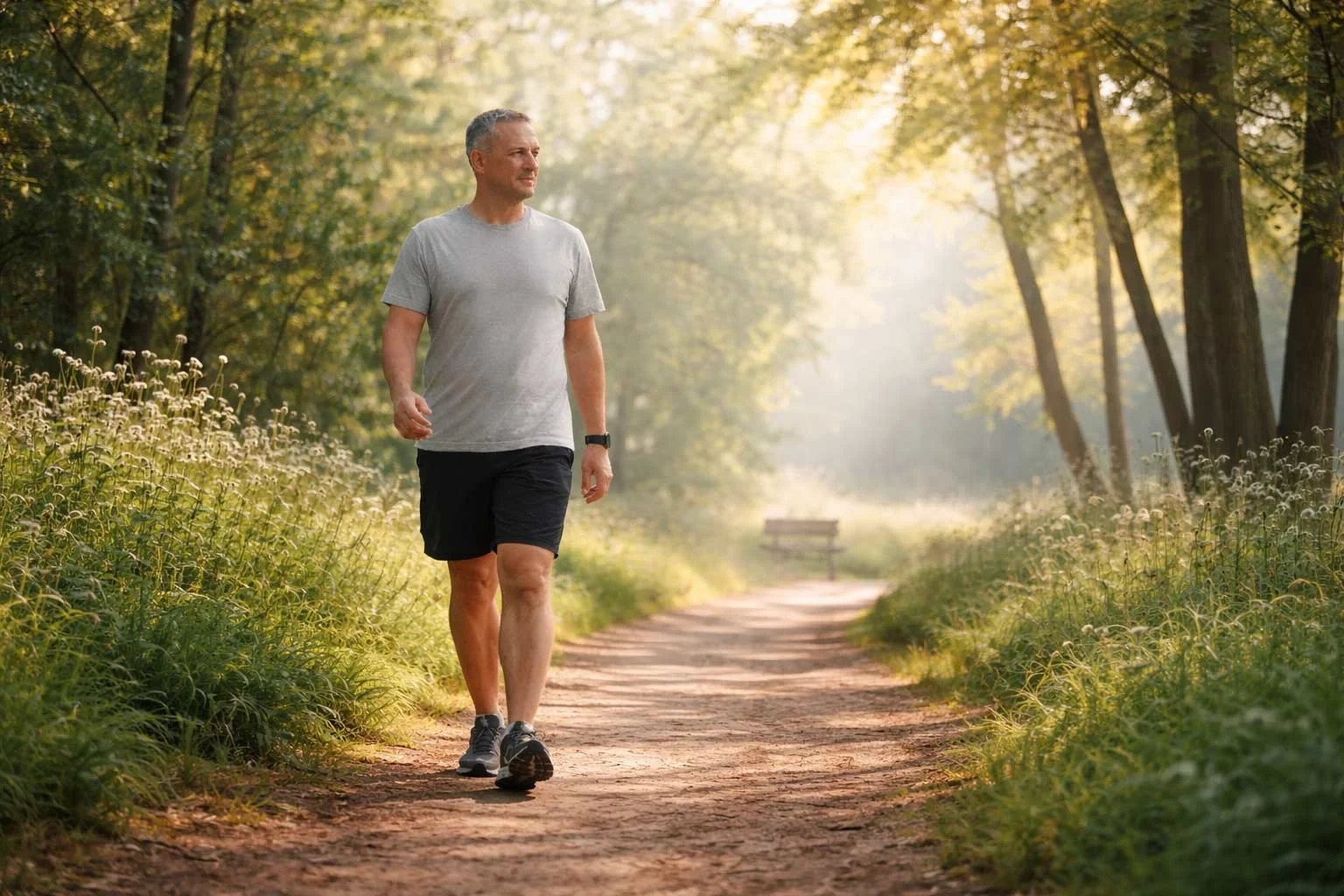
Walking is uniquely effective because it activates the body’s largest muscle groups without overwhelming recovery systems. Unlike high-intensity exercise, walking works with treatment physiology rather than against it.
Walking supports:
Blood sugar regulation and insulin sensitivity
Lean-muscle signaling
Cardiovascular function with low systemic stress
Lymphatic circulation (especially important during radiation)
Nervous-system regulation, reducing fatigue amplification
In my book Walking Works Blueprint, I explain why walking becomes so powerful during periods of stress and transition:
“Walking works because it meets your body where it is—then quietly moves it forward.”
During ADT and radiation, your body does not need shock. It needs rhythm, repetition, and reassurance.
Walking provides all three.
This is why men often report clearer thinking, better sleep, and fewer extreme energy crashes on days they walk—even briefly.
As I emphasize in the Walking Works Blueprint: “When walking is consistent, everything else becomes possible again.”
That consistency is the win during treatment.
Learn more about the framework here: Walking Works Blueprint
STRONG™ — T: Train Your Body (Treatment-Phase Definition)
In the STRONG™ framework, Train Your Body does not mean pushing harder.
During treatment, it means:
Preserving physical capacity
Maintaining metabolic signals
Preventing unnecessary decline
Creating a faster recovery runway post-treatment
Walking is not a compromise inside STRONG™. It is the primary training tool during this phase.
The Low-Energy Walking Micro-Framework
(How to Walk on the Days You “Don’t Have It”)
Not every day will feel the same—and that’s expected.
Walking is not a fallback—it’s a strategic intervention. I explain the science behind this in more detail in Why 15-Minutes of Brisk Walking May be the Secret to Longer, Healthier Life.
Here’s the rule that matters most:
On low-energy days, shorten the walk—don’t cancel it.
1. Reduce duration, not frequency
Even 5–10 minutes maintains the metabolic signal.
2. Slow the pace, keep posture tall
Relaxed arms, steady breathing, upright stance.
3. Stack short walks
Two or three brief walks outperform one long session when energy is limited.
4. Finish with energy left
You should feel slightly better afterward—not depleted.
Walking becomes a daily vote for recovery, not a test of toughness.
Protein Timing and Nutrient Density Basics
Muscle loss during ADT is influenced not just by hormones, but by how often your muscles receive protein signals.
Protein works best when spread evenly across the day—not saved for dinner.
Simple “Protein Anchor” Approach
No tracking required. One protein source per meal.
Breakfast options
Eggs (whole eggs or eggs + egg whites)
Plain Greek yogurt
Protein smoothie (whey or plant-based)
Lunch options
Grilled chicken or turkey
Tuna or salmon
Lentils or beans with whole grains
Dinner options
Lean beef, pork, or bison
Fish (salmon, cod, halibut)
Tofu or tempeh
The goal during treatment is muscle preservation, not muscle growth. Source: National Library of Medicine
The Real Solution Isn’t Pushing Harder—It’s Training Smarter
Fatigue, muscle loss, and weight gain during prostate cancer treatment are not personal failures.
They are biological responses.
The solution isn’t doing nothing.
The solution isn’t doing everything.
The solution is structure.
Structure that respects treatment realities while protecting your future strength.
That is where real progress begins.
If this helped explain what you’re experiencing, the next step is having simple structure you can rely on—especially on the hard days.
Staying Strong During Prostate Cancer
I created Staying Strong During Prostate Cancer to help men navigate treatment with clarity, confidence, and realistic expectations.
It’s a practical guide built around walking, energy management, and training smarter—not harder—during ADT and radiation.
No pressure. No spam. Just clear guidance during treatment and recovery.
This approach is part of the STRONG™ Through Prostate Cancer framework, which focuses on training smarter during treatment and rebuilding strength afterward.
Want to talk this through?
If you’re navigating prostate cancer treatment and want clarity on walking, fitness, and recovery—without pressure or sales tactics—you can schedule a STRONG™ Clarity Call with me.
This is not a sales call. It’s a conversation focused on your situation and next steps.
Walk on and stay strong,
Frank


