
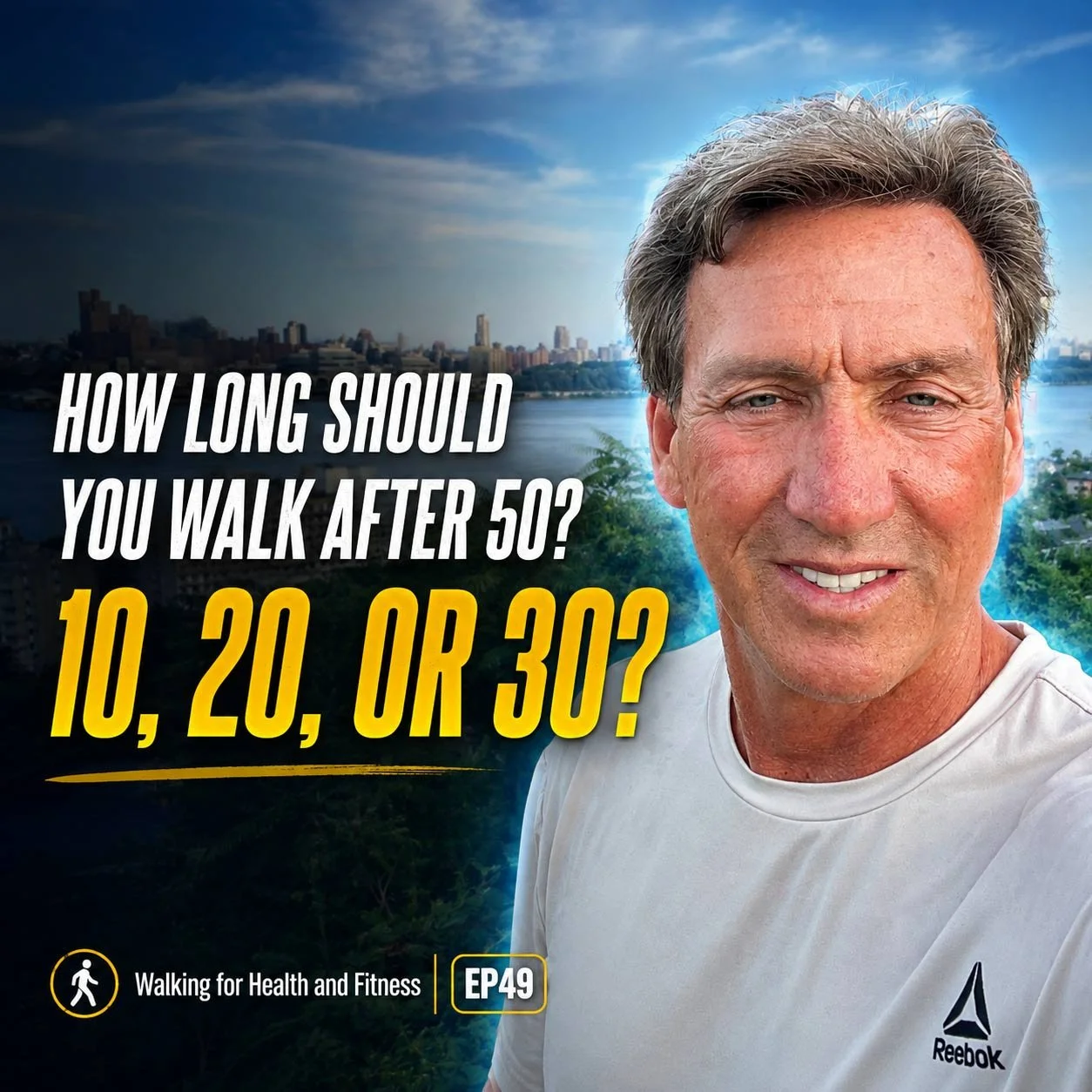
If you believe a walk only counts when it lasts 30 minutes, I want you to reconsider that idea.
I think the 30-minute rule actually prevents some people from walking. You look at the clock, realize you only have 10 or 15 minutes before your next appointment, dinner, work, or whatever else is going on in your life, and you think, “Well, I don’t have enough time for a real walk.”
So you don’t walk at all.
Then there’s the opposite problem. You haven’t exercised consistently in months, maybe longer, but you finally decide today is the day you’re getting back into shape. You lace up your shoes, head outside, feel pretty good, and decide to walk for an hour.
The next morning your legs are sore, your energy is shot, and instead of looking forward to another walk, you’re wondering if you overdid it.
There is a much better way to approach this.
The goal is not to see how long you can walk today. The goal is to choose a walking duration you can recover from, repeat, and gradually build upon.
That is what Episode 49 of the Walking for Health and Fitness Podcast is all about.
Watch or Listen to Episode 49
If you’re starting again after illness, injury, inactivity, or another major health setback, I also created a free 10-Minute Recovery Walk Reset to give you a simple place to begin.
You don’t need to prove how far you can walk. You need to answer a much more useful question:
What can I comfortably do today that I can come back and do again?
Is 30 Minutes of Walking a Magic Number?
Thirty minutes is an excellent amount of time to walk, but there is nothing magical about exactly 30 minutes.
Current physical activity guidelines recommend that adults work toward at least 150 minutes of moderate-intensity aerobic activity each week. Thirty minutes, five days a week, is simply an easy way of reaching that number.
But this is where many people misunderstand the recommendation. Your physical activity does not have to happen in one continuous 30-minute workout to provide value. Shorter periods of activity can be accumulated throughout the day and week.
That matters because it changes the way we think about exercise.
Instead of saying, “I don’t have 30 minutes, so I can’t walk,” you can ask, “How much time do I have today?”
Maybe you have ten minutes before breakfast. Maybe you have fifteen minutes at lunch. Maybe you have another ten minutes after dinner.
Those walks matter.
And if you’ve been inactive for a while, starting with ten minutes may actually make much more sense than immediately forcing yourself to walk for thirty.
The American Heart Association recommends that people who are rebuilding their endurance begin gradually. Starting with around 10 to 15 minutes and increasing from there can be a very reasonable approach.
This is one of the reasons I’ve used short walks throughout my programs for years. Ten minutes gives you enough time to get moving, see how your body responds, and begin rebuilding the habit without making the walk feel overwhelming.
The 10-20-30 Walking Duration Ladder
I like to keep things simple.
When you’re trying to decide how long to walk, think:
10. 20. 30.
I call this the 10-20-30 Walking Duration Ladder.
These numbers are not rigid rules and they certainly aren’t medical prescriptions. Think of them as three useful starting points. You simply choose the rung of the ladder that best matches where you are right now.
Not where you were ten years ago.
Not where your neighbor is.
Not where somebody on YouTube tells you that you should be.
Where you are today.
10 Minutes: The Restart Walk
Ten minutes is what I call the Restart Walk.
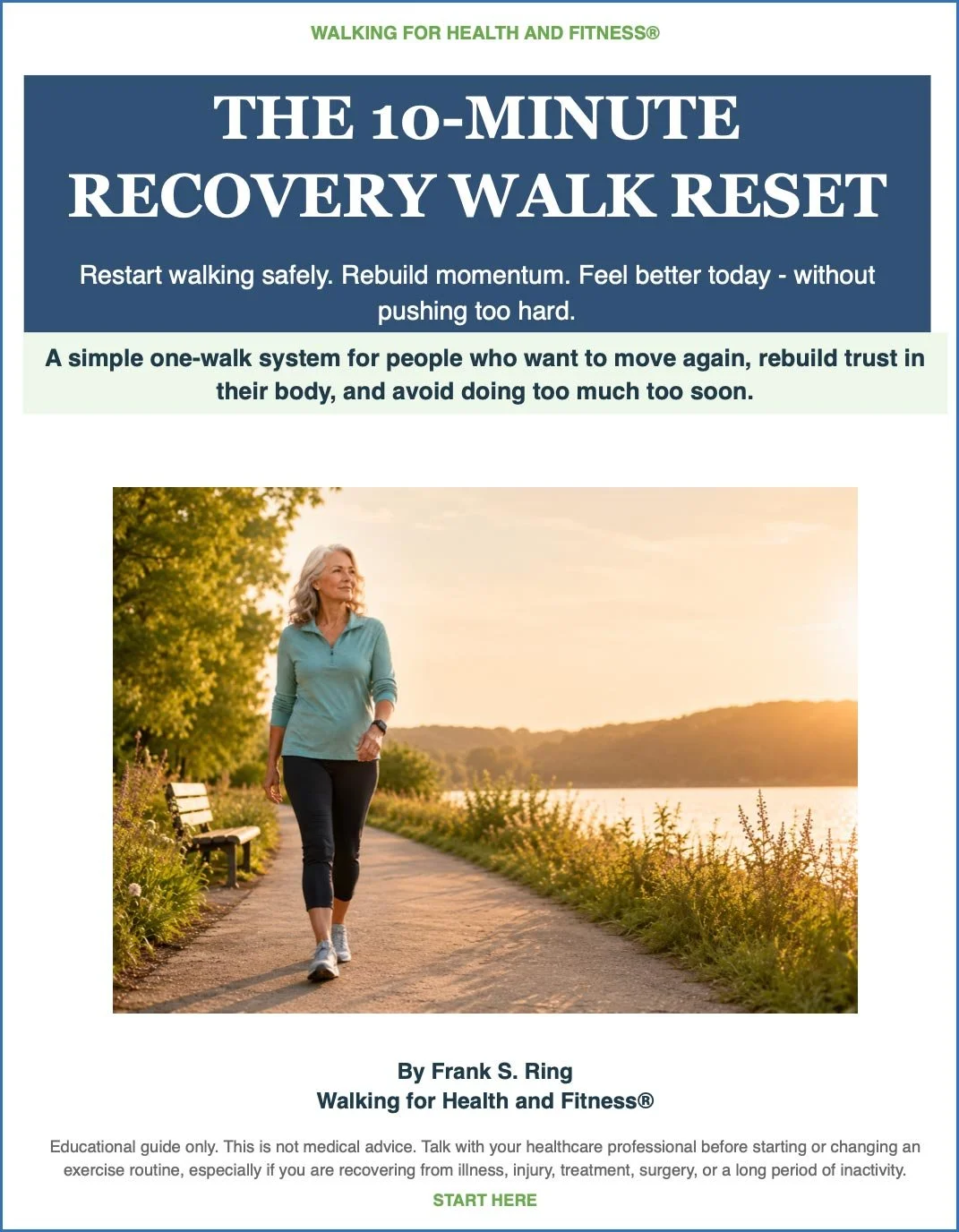
Download the Free Guide
If you haven’t exercised consistently in a while, you’re recovering from an illness or injury, your energy isn’t what it used to be, or you simply aren’t sure what your body can comfortably handle right now, ten minutes is a great place to begin.
There’s also a psychological advantage to ten minutes.
Thirty minutes can sound like a workout.
An hour definitely sounds like a workout.
Ten minutes sounds like, “I can do that.”
And getting out the door is often the hardest part.
Once you’re walking, those ten minutes give you valuable information. How is your breathing? How do your legs feel? How is your energy? How do you feel when you get home?
And there is another question I think is even more important:
How do you feel tomorrow?
That tells you a lot.
You’re not taking an endurance test. You’re gathering information about your current fitness level.
And if ten minutes is too much right now, walk five.
There is nothing wrong with starting smaller. Your starting point is simply your starting point.
20 Minutes: The Building Walk
Once ten minutes begins to feel comfortable and repeatable, twenty minutes becomes a very useful next step.
I call this the Building Walk.
Twenty minutes gives you enough time to begin developing more endurance without turning every walk into a major commitment. It also fits into real life extremely well.
Twenty minutes before work. Twenty minutes at lunch. Twenty minutes before dinner.
Most of us can find twenty minutes much more easily than we can find an uninterrupted hour.
This gets back to one of the most important principles I teach:
Consistency beats the heroic workout.

I would much rather see you complete three or four 20-minute walks during the week that you enjoy and recover from than one 75-minute walk that leaves you exhausted and makes you avoid walking for the next several days.
Your walking program does not have to impress anyone.
It has to work for you.
30 Minutes: The Foundation Walk
Once you can comfortably and consistently walk for thirty minutes, you’ve developed a very useful level of walking endurance.
I call this the Foundation Walk.
This is also where the familiar 150-minute weekly recommendation starts to make sense. Five 30-minute walks gives you 150 minutes for the week.
But I want to emphasize this point because I think it gets lost:
Thirty minutes may be a goal for one person and a starting point for another.
We are not all beginning from the same place.
Your age matters. Your current fitness matters. Your health matters. Your energy matters. Your available time matters. And the reason you’re taking the walk matters.
That last point is especially important.
What Is the Purpose of Today’s Walk?
Instead of always asking, “How long should I walk?” start asking yourself another question:
What job does this walk need to do today?
Not every walk has to accomplish the same thing.
Maybe today is a recovery walk. You’re tired from yesterday, but you still want to move your body. Ten or fifteen easy minutes may be exactly what you need.
Maybe today is a building walk. Twenty or thirty minutes at a comfortable pace gives you the opportunity to work on your endurance.
Maybe it’s a beautiful Saturday morning, you’re feeling strong, and you want to go out for a longer walk simply because you enjoy it.
Or maybe you’ve had one of those days. You’re stressed, your mind is racing, and you need to get outside and clear your head.
That walk may have very little to do with fitness and everything to do with feeling better.
There are also days when the purpose of the walk is simply to keep the habit alive.
You promised yourself you were going to walk today. You only have twelve minutes.
Take the twelve-minute walk.
It counts.
This is one of the biggest shifts I want you to make in how you think about walking. Different walks can have different purposes, and different walks can last different amounts of time.
That flexibility makes your walking routine much easier to sustain.
Make Walking Fit Your Life
Let’s say you normally walk for 30 minutes, but today you only have 15.
Should you skip the walk?
I wouldn’t.
Take the 15-minute walk.
You didn’t fail your walking program.
You adapted your walking program.
There is a big difference.
A walking system has to survive real life.
It has to survive busy days, vacations, bad weather, work deadlines, family responsibilities, low-energy days, and all the unexpected things that happen during a normal week.
If your walking program only works when everything in your life goes perfectly, it isn’t much of a system.
It’s a temporary routine.
I want you to build something you can keep doing.
How Do You Know When It’s Time to Walk Longer?
This is where I want you to begin paying attention to your body rather than automatically adding more time simply because another week has passed.
I use what I call my Green-Light Questions.
Ask yourself: Am I recovering by the following day? If I have some soreness, is it mild and getting better? Is my energy staying reasonably stable? Am I beginning to look forward to walking rather than dreading it? And could I realistically repeat this same walking schedule again next week?
If most of those answers are yes, you may have the green light to add a little more.
If most of those answers are no, adding more walking time probably isn’t the smartest move yet.
Your body is constantly giving you information.
You just have to listen to it.
The One-Change Rule
There are three major things we can change in a walking program.
How many days we walk.
How long we walk.
And how hard we walk.
In other words: Frequency. Duration. Intensity.
This is where people often get into trouble.
They’ve had a good week, so suddenly they decide they’re going from three days of walking to five. At the same time, they increase their walks from fifteen minutes to thirty minutes. And since they’re feeling motivated, they also decide to start walking much faster.
Everything changes at once.
A simple walking program suddenly becomes a much bigger physical demand.
Instead, use what I call the One-Change Rule.

Change one major variable at a time.
If you just increased the number of days you’re walking, let your body adjust before dramatically increasing your walking time.
If you’re increasing how long you walk, keep your frequency and intensity fairly stable and see how your body responds.
Make the change.
Recover.
Evaluate.
Then decide what comes next.
That is a much smarter way to build fitness.
A Simple Way to Increase Your Walking Time
Let’s say you’re currently walking for ten minutes, three days per week.
Ten minutes now feels easy and repeatable.
You do not have to suddenly make every walk thirty minutes.
Maybe next week you walk ten minutes, ten minutes, and fifteen minutes.
That’s it.
Then see what happens.
How did you feel after that fifteen-minute walk? How did you feel later that day? How did you sleep? How did your legs feel the next morning?
Could you repeat the week without feeling beat up?
If everything looks good, you can gradually build from there.
The five-minute increase I’m using in this example isn’t some universal rule. I simply like the idea of making the change small enough that you can clearly observe how your body responds.
In fact, I often want you to finish your walk thinking:
“I could have done a little more.”
That is a much better feeling than finishing completely exhausted and thinking:
“I never want to do that again.”
Longer Is Not Automatically Better
Now, if you already enjoy walking for 45 minutes, an hour, or even longer, I’m certainly not telling you to stop.
If you’ve developed the fitness, you’re recovering well, and long walks are something you enjoy, keep walking.
Longer activity can provide additional health and fitness benefits.
But that doesn’t mean every walk needs to become an endurance test.
Maybe your week includes a couple of shorter walks, several moderate walks, and one long walk.
That variety can make your walking program more enjoyable and much easier to maintain.
Remember something I’ve written about for years:
You are not training for the Olympics. You are training for your own Olympics—the Olympics of the rest of your life.
The goal isn’t to squeeze every possible minute of exercise out of your body today.
I want you walking next month.
Next year.
Ten years from now.
And hopefully decades from now.
The Walking Duration Trap After 50
I think this is one of the biggest challenges for adults over 50.
We remember what we used to be able to do.
You remember the five-mile run.
The hour-long gym workout.
The long hike.
The basketball game that went on all afternoon.
Then life happens.
Work becomes demanding. Family responsibilities grow. An injury happens. An illness happens. You spend years being less active than you once were.
Then one morning you decide, “That’s it. I’m getting back in shape.”
The problem is that you sometimes choose today’s workout based on the person you were twenty years ago.
That is where frustration begins.
Stop using your old body to set today’s starting point.
Establish today’s number.
Maybe it’s ten minutes.
Maybe it’s twenty.
Maybe it’s thirty.
Maybe it’s much longer.
The number itself isn’t what matters.
What matters is whether that number helps you keep moving forward.
A STRONG Message for Men Going Through Prostate Cancer

I also want to speak directly to the men reading this who are dealing with prostate cancer.
And if you—or someone you love—is going through prostate cancer treatment or recovery, this STRONG message is for you.
Walking duration can take on a completely different meaning when you’re going through cancer treatment.
I learned that firsthand.
Going through prostate cancer treatment changed the way I looked at exercise, recovery, energy, and even what it meant to feel physically strong.
You may remember walking three miles without even thinking about it.
You may remember being able to work out for an hour.
Then treatment begins and ten or fifteen minutes suddenly feels completely different.
That can be difficult mentally because we tend to compare ourselves with the man we were before treatment.
I had to learn to stop doing that.
Don’t judge today’s body by yesterday’s abilities.
Cancer treatment can affect your energy, strength, endurance, recovery, and many other aspects of how you feel physically. That means the correct walking duration today may be very different from what it was before treatment.
One day, twenty or thirty minutes may feel great.
Another day, ten minutes may be enough.
And on a particularly difficult day, simply getting outside and moving for a few minutes may be your win.
That walk still counts.
Staying STRONG does not mean forcing yourself to push through severe fatigue just to prove something.
STRONG means paying attention.
It means adapting.
It means doing what you reasonably can today, recovering from it, and giving yourself the opportunity to come back and move again.
Treatment fights the cancer.
But the things you do each day can help rebuild the man going through it.
Walking may be one of those first actions.
If you’re going through prostate cancer treatment, I created a free resource called
5 Things No One Tells Men About Staying Strong During Prostate Cancer Treatment.
It covers several of the lessons I wish more men understood about treatment, recovery, strength, energy, and mindset.
Walk on. Stay steady. Stay STRONG.
Your Walking Challenge
Here’s what I want you to do this week.
For your next three walks, decide how long you’re going to walk before you leave the house.
It might be ten minutes.
Twenty.
Thirty.
Or another number that makes sense for you.
Then when you get home, don’t simply look at your watch and congratulate yourself for accumulating a certain number of minutes.
Pay attention to how you feel.
Did you finish with something left in the tank? How was your energy afterward? How did you recover? How did you feel the following morning? Could you realistically repeat that same walk again?
Those answers can tell you much more than the number on your watch.
Because at this point, we’re not simply going out and walking randomly.
We’re building your walking system.
So, How Long Should You Walk After 50?
There isn’t one number that works for everyone.
That’s why I want you to remember the 10-20-30 Walking Duration Ladder.
Ten minutes is your Restart Walk.
Twenty minutes is your Building Walk.
Thirty minutes is your Foundation Walk.
Then make the system your own.
Some days you’ll walk less.
Some days you’ll walk more.
And that is perfectly fine.
The walking program that changes your health probably won’t be the most impressive workout you ever complete.
It will be the one you keep coming back to.
If you’re just getting started again, begin with my free 10-Minute Recovery Walk Reset.
One walk.
Ten intentional minutes.
A chance to see how your body responds and build your first win.
Coming Next: How Hard Should You Walk After 50?
We’ve now answered two of the major questions you need to build a walking program.
How many days should you walk?
How long should you walk?
Now there’s one major piece left:
How hard should you walk?
Should every walk be brisk? What does the Talk Test actually tell you? How do you know if you’re walking too slowly? And how do you know when you’re pushing too hard?
That’s exactly what we’ll cover in Episode 50.
Frequency.
Duration.
Intensity.
Put those three pieces together and you begin building a walking system around your body, your life, and your goals.
Until then...
Walk on,
Frank S. Ring
Author: Walking for Health and Fitness, Fitness Walking and Bodyweight Exercises, Walking Inspiration, Walking Logbook Journal , and Walking Works Blueprint
Frequently Asked Questions
Is a 10-minute walk worth doing?
Absolutely. Short periods of walking can contribute to your overall physical activity, and for someone who has been inactive, ten minutes can be an excellent way to begin rebuilding a walking habit. More importantly, if ten minutes is something you can comfortably repeat, you now have a foundation to build upon.
Do I have to walk for 30 continuous minutes?
No. Thirty minutes is a convenient and useful walking duration, but you do not have to complete all of your daily activity in one continuous session. Shorter walks throughout the day can contribute to your weekly activity.
How long should a beginner walk?
There isn’t one starting number that works for everybody. If you’ve been inactive, 10 to 15 minutes may be a reasonable place to begin, but some people should start with even less. Your fitness level, health history, symptoms, and medical circumstances all matter.
When should I increase my walking time?
Increase when your current amount of walking feels manageable, you are recovering well, your energy is reasonably stable, and you feel confident that you can repeat the current schedule. Progress gradually instead of increasing your walking days, walking time, and intensity all at once.
Medical Disclaimer
The information in this article is provided for educational and informational purposes only and is not intended as a substitute for individualized medical advice. If you have a medical condition, are recovering from illness or injury, are undergoing cancer treatment, or have concerns about beginning or increasing exercise, talk with your physician or appropriate healthcare professional.
Sources
U.S. Department of Health and Human Services — Physical Activity Guidelines for Americans
https://odphp.health.gov/our-work/nutrition-physical-activity/physical-activity-guidelines
American Heart Association — Endurance Exercise
https://www.heart.org/en/healthy-living/exercise-and-physical-activity/fitness-basics/endurance-exercise-aerobic
Centers for Disease Control and Prevention — Physical Activity Basics
https://www.cdc.gov/physical-activity-basics/guidelines/adults.html
American Cancer Society — Physical Activity When You Have Cancer
https://www.cancer.org/cancer/supportive-care/nutrition-activity-with-cancer/physical-activity-when-you-have-cancer.html


