
How many days a week should you walk after 50? Three? Five? Every day?
If you are starting—or restarting—a walking routine, it is easy to believe that the more days you walk, the better.
But that can create a problem.
You may choose a walking schedule based on where you think you should be instead of where your body, fitness level, and lifestyle actually are today.
You start with enthusiasm. You try to walk every day. Then soreness, fatigue, bad weather, a busy schedule, or one missed workout throws everything off.
Before long, you have stopped walking again.
The better question is not:
“How many days can I force myself to walk?”
It is:
“How many days can I walk and realistically repeat again next week?”
That is the idea behind my 3-4-5 Walking Plan.
Start With 3 Walking Days
If you have been inactive, are returning after a long break, or have recently restarted exercising, begin with three walking days per week.
For example:
Monday — Wednesday — Saturday
Your walks do not need to be long.
Five, 10, or 15 minutes can be enough to establish the pattern:
Walk. Recover. Walk again.
Three successful walking days are far more valuable than planning to walk seven days and completing only two.
Your first goal is consistency.
Not intensity.
Not mileage.
Not an impressive step count.
You are building evidence that says:
“I am becoming someone who walks regularly.”
Progress to 4 Walking Days
Once three days feels manageable and repeatable, consider adding a fourth walking day.
But make an important distinction:
Walking more frequently does not mean walking harder every time.
Your fourth day could simply be a short recovery walk.
A four-day week might look like:
Monday: Comfortable walk
Wednesday: Brisker walk
Friday: Comfortable walk
Sunday: Easy recovery walk
Different walks can have different purposes.
Some help improve fitness. Others build endurance. Some simply reinforce the habit.
That variety is one reason a walking system can be more effective than randomly deciding what to do each day.
Build Toward 5 Walking Days
Eventually, many adults can build toward five days of activity each week.
Current CDC guidance recommends that adults accumulate at least 150 minutes of moderate-intensity aerobic activity per week, which can be spread throughout the week. For adults 65 and older, muscle-strengthening and balance activities are also recommended.
But there is an important point:
Thirty minutes on five days is a destination—not necessarily your starting assignment.
The National Institute on Aging recommends increasing physical activity gradually, beginning at an intensity appropriate for your current fitness level and then building frequency, duration, and intensity over time.
That leads to the next part of the system.
Use the Green-Light Questions
Before progressing from three days to four—or four to five—ask yourself:
1. Am I recovering by the following day?
2. Is any soreness mild and improving?
3. Is my energy reasonably stable?
4. Am I beginning to look forward to walking?
5. Can I realistically repeat this schedule next week?
I call these the Green-Light Questions.
They help you make progression a decision based on your body and your life rather than an arbitrary number on a calendar.
If your answers are mostly yes, you may be ready to add another walking day.
If not, repeat the week.
Repeating a manageable week is not failure.
It is training.
Follow the One-Change Rule
There are three major variables you can increase in a walking program:
Frequency — how often you walk
Duration — how long you walk
Intensity — how hard you walk
My One-Change Rule is simple:
Do not significantly increase all three at once.
If you currently walk three days per week for 15 minutes at a comfortable pace, you might:
Add a fourth day.
OR
Make one walk slightly longer.
OR
Add a few brief periods of faster walking.
Avoid suddenly going from three comfortable 15-minute walks to five brisk 30-minute walks.
Your motivation may be ready for that jump.
Your body may not be.
The One-Change Rule gives your body time to adapt while allowing you to continue progressing.
What If You Are Going Through Prostate Cancer Treatment?
This lesson is especially important for men dealing with prostate cancer treatment, ADT, radiation, or recovery.
Your recovery may sometimes determine your walking frequency more than your motivation.
Three walking days may be right for you right now.
Ten minutes may be enough on a difficult fatigue day.
An easy walk still counts.
The American Cancer Society advises people undergoing or recovering from cancer treatment to begin activity slowly and increase it gradually based on treatment, symptoms, energy level, and physical condition. Short, slow walks can be an appropriate starting point for people who have been inactive or are experiencing treatment-related fatigue.
Work with your cancer-care team when determining what activity is appropriate for your individual situation.

Your Step Forward Challenge
Do this today.
Choose your current level:
3 days
4 days
or
5 days
Then put the exact walking days on your calendar.
Do not write:
“I'll walk three times this week.”
Write:
Monday, Wednesday, Saturday.
Then establish your minimum.
Your minimum walk can be just five minutes.
You are always free to do more.
But five minutes gives you a starting point you can complete even when motivation is low.
Start With One 5-Minute Walk
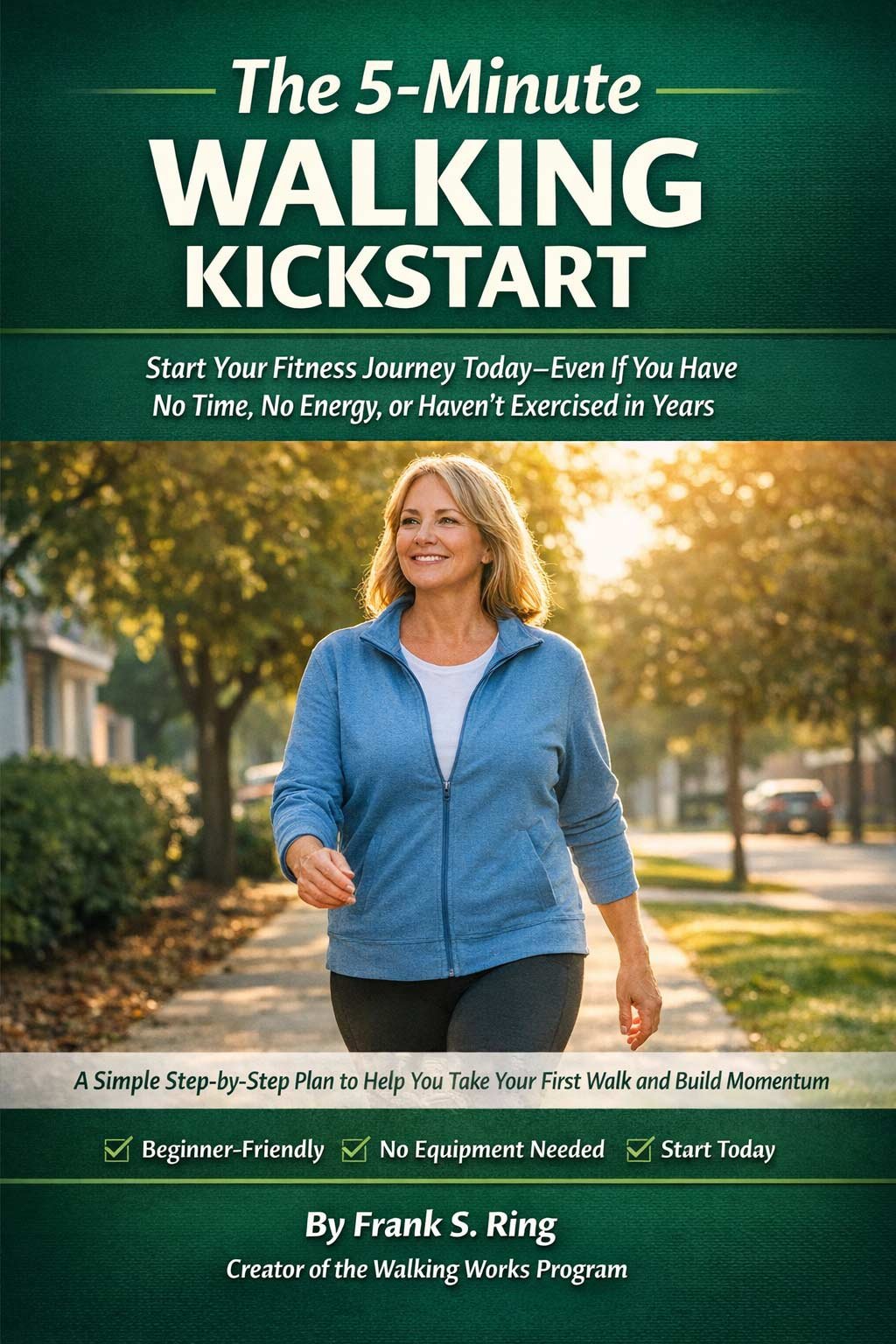
If you have been struggling to restart, I created the FREE 5-Minute Walking Kickstart specifically to help you take that first manageable step.
➡️ Download the FREE 5-Minute Walking Kickstart <<<
Take the walk.
Record the win.
Schedule the next one.
Because you do not become a walker by completing one heroic workout.
You become a walker by returning.
Ready to Stop Guessing What to Do Next?
Knowing whether to walk three, four, or five days is useful.
But eventually another question appears:
“What exactly should I do on those walking days?”

That is why I created Walking Works: Build Your Lasting Walking Habit, my 14-Day Quick-Start Walking Program.
Walking Works provides structured walking instruction, varied walking sessions, progress tracking, mindset strategies, and daily guidance designed to help you turn walking information into a repeatable habit.
➡️ Learn more about Walking Works <<<
Walk on—because one walk can change your day.
The next one can change your life.
Frank S. Ring
Author: Walking for Health and Fitness, Fitness Walking and Bodyweight Exercises, Walking Inspiration, Walking Logbook Journal , and Walking Works Blueprint


