Prostate cancer treatment doesn’t just affect the body—it disrupts certainty, identity, focus, and the routines men rely on to feel strong.
Prostate cancer treatment doesn’t just affect the body.
It disrupts certainty, identity, focus, and the routines men rely on to feel strong.
In Episode 35 of the Walking for Health and Fitness Podcast, I shared something I rarely hear discussed honestly—what happens when the strategies that once kept you grounded stop working the way they used to.
Not because you stopped caring.
Not because you stopped trying.
But because your body, your energy, and your identity are all being challenged at the same time.
This post expands on that conversation and explains why walking is essential—but not sufficient—during prostate cancer treatment and recovery.
The “Fog of War” During Prostate Cancer Treatment
Many men going through prostate cancer treatment experience confusion—not panic, not weakness, but a lack of clarity.
You’re given:
Information
Appointments
Numbers
Options
But very little guidance on how to live inside the experience.
You’re told:
Stay active
Walking is good
Manage stress
All of that is true.
What often goes unspoken is this:
the body you’re living in during treatment is not the body you used to know.
Energy changes.
Recovery changes.
Confidence changes.
And quietly, identity begins to shift.
I call this state the fog of war—doing the right things, showing up, yet feeling internally misaligned.
Walking During Treatment: The Honest Truth
I want to be very clear about something.
I did walk during prostate cancer treatment.
Walking never disappeared from my life.
But I did not walk the way I had before treatment.
Before treatment, walking was rhythmic and grounding—it was part of who I was.
During treatment, that rhythm was disrupted. Not because I stopped believing in walking, but because I was operating inside the fog of war.
At the same time, medical guidance recommended resistance training to reduce muscle loss during treatment. That advice was sound—and I followed it.
In doing so, I injured my shoulder.
That injury mattered, not just physically, but psychologically. Movement suddenly felt risky. I still walked—but with less ease, less volume, and less confidence.
I didn’t stop walking.
I lost momentum.
Even with decades of experience, books, and teaching behind me, I found myself somewhat lost—not because walking didn’t work, but because I lacked a framework that matched the season I was in.
Why Consistency Quietly Breaks Down
Consistency didn’t break down because of laziness or lack of discipline.
It broke down because I no longer felt physically strong.
When capability has been part of your identity, losing that feeling—even temporarily—changes how you see yourself.
Instead of adapting, I tried to outperform treatment.
I chased the perfect workout.
The perfect routine.
The perfect way to “handle” treatment.
What I see clearly now is this:
progress beats perfection—especially during treatment.
And sometimes, real recovery requires stepping back, resting, and allowing the body to heal under a heavy physiological load.
Research supports this.
Studies published in the Journal of Clinical Oncology and European Urology show that men undergoing androgen deprivation therapy (ADT) commonly experience fatigue, reduced physical performance, sleep disruption, and emotional distress—even when remaining active.
Cancer-related fatigue is not the same as being “out of shape.”
Pushing through it as if it were often backfires.
🎁 Free STRONG™ Guide for Men in Treatment
If you’re currently going through prostate cancer treatment—or supporting someone who is—I created a free guide to help you stay grounded during this phase.
How STRONG™ Was Born
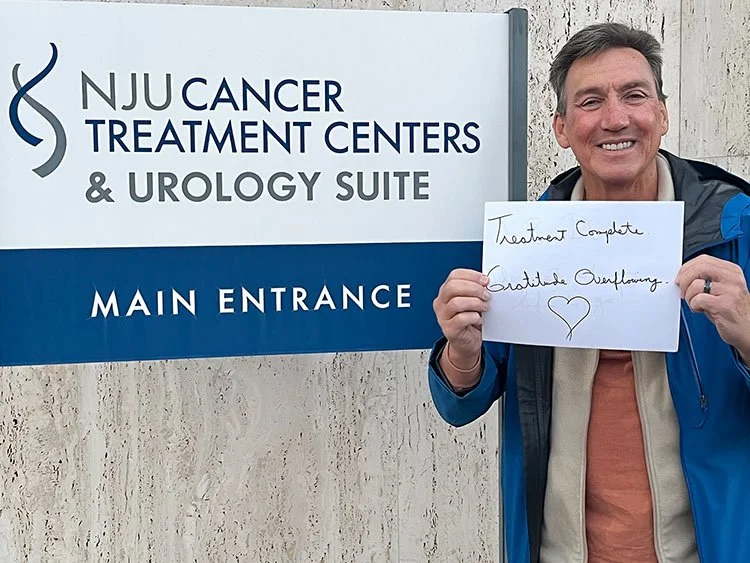
I did it! 28 radiation treatments completed! October 23, 2025.
After completing 28 radiation treatments, something shifted.
Up until that point, my focus was simple:
Just get through this.
Once treatment ended, a new question emerged:
What now?
Initially, I tried to get back to the old me.
But that version of me hadn’t been through what I had been through.
The real work began when I stopped trying to go backward and started building forward.
I rebuilt from the inside out:
Morning reading and reflection
Gratitude journaling
Walking with presence, not performance
Yoga to release physical and emotional tension
Intentional rest and supportive nutrition
Research in psycho-oncology shows that recovery improves when physical activity is paired with mindset work, emotional processing, and structured routines.
That sequence matters.
This is when STRONG™ took shape—not as a program, but as a framework.
Not about going back.
About becoming STRONG 2.0.
Why Walking Alone Is Not Enough
Walking remains the foundation of everything I teach.
But walking alone doesn’t address:
Identity shifts
Mental fatigue
Hormonal changes
Emotional disconnection
The need for structure during uncertainty
STRONG™ exists to build structure around walking—not replace it.
It supports the whole man, not just the movement.
🎁 Free STRONG™ Guide for Men in Treatment
If you’re currently going through prostate cancer treatment—or supporting someone who is—I created a free guide to help you stay grounded during this phase.
STRONG™ During Treatment explains:
What’s really happening to your body and mind
Why consistency feels harder than expected
How to stay active without pushing too hard
How to navigate the fog of war with structure
No pressure.
Just support.
You Don’t Have to Navigate This Alone
If this page helped you put words to something you’ve been experiencing—
and you’re feeling unsure about how to move forward during or after prostate cancer treatment—
I offer a STRONG™ Clarity Call.
A Clarity Call is not a sales call.
It’s a focused, confidential conversation designed to help you:
Talk through where you are physically, mentally, and emotionally
Understand why certain routines may no longer be working
Gain clarity on what kind of support would actually help right now
Decide your next step with confidence, not pressure
There is no obligation.
Just clarity.
Schedule a STRONG™ Clarity Call
Walk on and STRONG,
Frank


